Rosario, Sep 1 (V7N)- The little boy who once sold lights in the alleys of Rosario has finally said goodbye to Argentina's national team.
Or has he?
Did Lionel Messi really announce his retirement from international football? Even knowing that such a day would eventually come, the reality still feels difficult to accept. The thought of seeing Messi step away from the Argentina jersey is enough to leave football fans around the world with a heavy heart.
He is often called the God of football. But before everything else, he is human. And every human journey eventually reaches its final chapter.
Today, that chapter appears to have arrived.
Nobel laureate Bob Dylan once asked in poetic rhythm how many roads a person must walk before becoming who they are meant to be. In football, perhaps the answer can be found in Messi's extraordinary journey.
After Argentina won the 2022 World Cup, Brazil's Globo newspaper published a remarkable headline: “Football has paid its debt.”
Why would a newspaper from Argentina's greatest football rival celebrate Messi in such a way?
Because Brazil understands football. A nation that breathes and lives the sport knows better than most what Messi has given to the game—and what the game has received from him.
Even Brazil's legendary Pele recognized that Messi deserved the World Cup.
But why did Messi deserve it when generations of extraordinary footballers have played the sport?
Perhaps because Messi was never simply a footballer.
For years, Barcelona were described as “more than a club.” Messi became an inseparable part of that identity. In the same way, he became something more than a player for football itself.
More than statistics
Football is a game of speed, stamina, strategy and instinct. Messi added something else to that vocabulary: beauty and intelligence.
In a fraction of a second, he can decide whether to pass, dribble or shoot. He can change the rhythm of an entire match without appearing to force the game.
That is what makes him different.
For many football lovers, watching Messi play has been its own kind of therapy. On difficult, tiring or stressful days, revisiting one of his extraordinary moments can bring back a sense of joy.
His achievements are almost impossible to list completely.
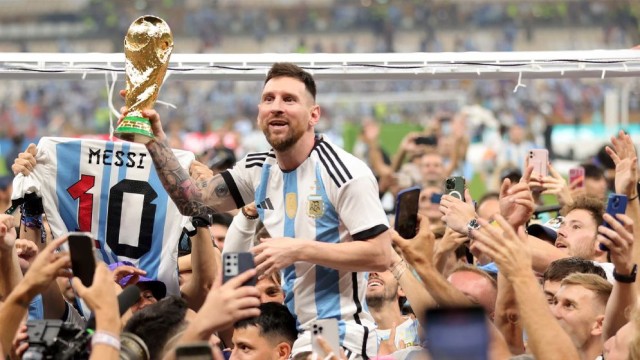
Eight FIFA world player-of-the-year awards. Copa América. Finalissima. Champions League. Olympic gold. FIFA U-20 World Cup. Club World Cup. And, finally, the World Cup that had eluded him for so long.
In 2014, he came painfully close. In 2022, he finally lifted the trophy in Qatar.
Then came the 2026 World Cup.
At 39, an age when most footballers have long since retired, Messi once again carried Argentina deep into the tournament. He scored eight goals and provided three assists, leaving another unforgettable mark on what was expected to be his final World Cup.
Across a record six World Cup appearances, Messi has scored 21 goals and provided 12 assists.
For Argentina, he has scored 125 goals in 207 appearances and contributed 68 assists.
Yet even these numbers cannot adequately measure Messi's influence.
The GOAT beyond numbers
The English media, despite coming from one of Argentina's historic football rivals, have repeatedly described Messi as the greatest of all time.
The reason is simple.
Messi does not merely play football with his feet. He plays it with his mind.
His greatest weapon has never been brute strength or sheer speed. It is his ability to see possibilities before others do.
His seemingly effortless movements can suddenly change the entire direction of a match. A slow step, a sudden turn, a perfectly weighted pass or a delicate finish can produce something that appears almost impossible.
The 2026 World Cup provided another reminder of that extraordinary ability.
German philosopher Martin Heidegger described human existence through the concept of Dasein—“being there.” For Heidegger, human beings are different because they are conscious of their own existence. They can ask why they are here and what their existence means.
Perhaps football has its own version of Dasein.
Many legends simply existed within football history.
Messi became conscious of what football could be.
He did not merely play the game. He changed the way millions of people saw it.
That is why his legacy cannot be measured by trophies, goals or assists alone.
As long as football exists, Lionel Messi will remain more than a footballer.
The little boy from Rosario became Argentina's greatest footballing symbol, conquered the world's biggest stages and gave generations of fans memories that will outlive his playing career.
And now, if this truly is the farewell, football is left with one final emotion:
Gratitude.
Farewell, Lionel Messi.
More than a footballer.
END/SMA/AJ