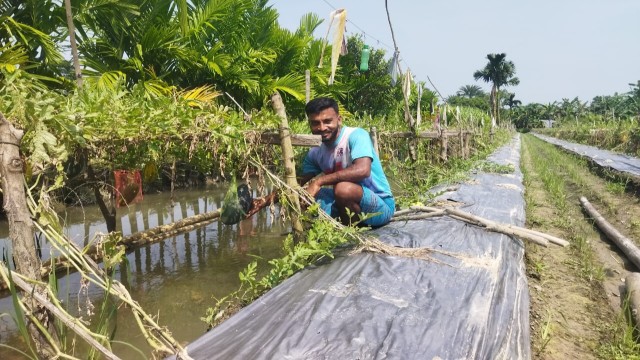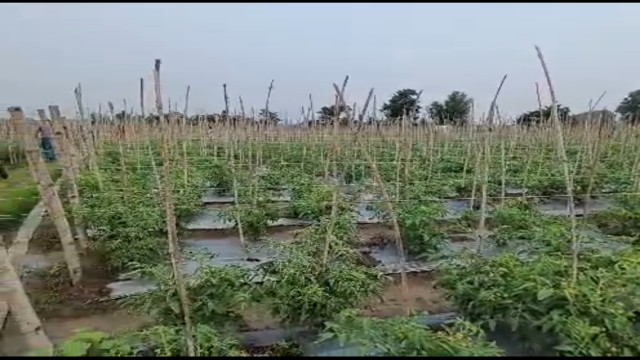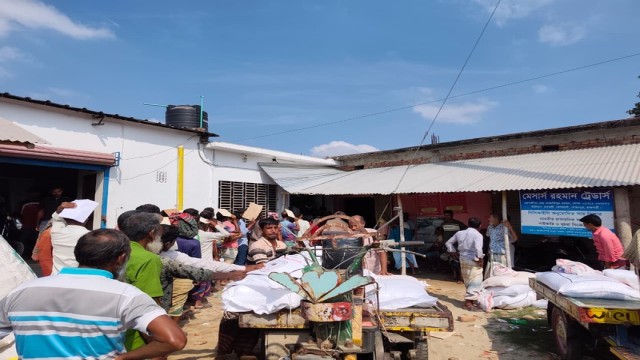
Rajshahi, Nov 3 (V7N) – Farmers across the Rajshahi region are struggling to obtain fertiliser during the busy winter crop cultivation season, with many having to wait for hours or even overnight outside dealers’ shops to collect limited quantities.
As farmers prepare land, sow seeds and transplant seedlings, they need fertiliser for their crops. However, many say they are receiving only one or two bags after standing in long queues, although their actual requirements are several times higher. The shortage of supplies at dealer points is disrupting cultivation, they said.
Farmers allege that although authorities repeatedly say there is no fertiliser shortage in the country, the situation at the field level tells a different story. They claim that allocations are far below local demand, while retail shops are also unable to provide fertiliser in the quantities farmers need.
The situation has also changed the way farmers purchase agricultural inputs. Many who previously bought fertiliser and pesticides on credit and paid after selling their crops are now being asked to pay in cash. This has increased financial pressure, particularly on small and marginal farmers.
Shafiqul Islam, a farmer from Modonhati village in Paba upazila of Rajshahi, went to the dealer point of Messrs Rahman Traders in Kesharhat area of Mohanpur upazila at around 6:30am on Sunday. After waiting in line for six hours, he received one bag of DAP and one bag of MOP fertiliser around noon.
However, he needed at least five bags of each type.
“I plan to cultivate onions, cauliflower and garlic on 10 bighas of land. But I am not getting the fertiliser I need from the dealer. How can I continue cultivation with such a small quantity?” he said.
Fazr Ali, another farmer from the same area, said each farmer was being given only one bag of DAP and one bag of MOP fertiliser.
“The fertiliser I received today will be enough for only one bigha of land. What will I use on the rest of my fields?” he said.
Shamim Hossain, a farmer from Chapainawabganj Sadar upazila, said he had spent the entire night outside a dealer’s shop to collect one bag of fertiliser for his mango and maize cultivation.
“Collecting fertiliser has become a time-consuming and difficult task for farmers like me,” he said.
Nazmul Hossain of Baharampur village in Godagari upazila said he previously bought fertiliser and pesticides on credit from retail shops and paid after harvesting and selling his crops.
“Now I have to pay cash to collect fertiliser. This has created additional financial pressure on us,” he said.
Bikash Chandra, a farmer from Dhamin Naogaon village in Mohanpur upazila, said he previously could buy fertiliser from retail shops in the quantities he needed and sometimes on credit.
“Now, even to get one particular type of fertiliser, I have to buy a full bag and also purchase another type along with it,” he said.
Information provided by fertiliser dealers also points to a significant gap between allocations and local demand.
Abul Hossain, a Bangladesh Chemical Industries Corporation (BCIC) dealer at Joybangla Mor in Kalikapur Union of Manda upazila in Naogaon, said his allocation for October was 200 bags of DAP, 182 bags of MOP, 90 bags of TSP and 900 bags of urea.
However, he said monthly demand in his area was around 2,500 bags of DAP, 2,400 bags of MOP and 600 bags of TSP. The figures indicate that allocations of DAP, MOP and TSP are several times lower than the estimated local requirements.
Osman Ali, a Bangladesh Agricultural Development Corporation (BADC) dealer at Baneshwar Bazar in Puthia upazila of Rajshahi, said he received only 60 bags of DAP fertiliser in October.
“There are around 1,000 farmers in my area, and at least 200 of them need fertiliser. But because of the limited allocation, it is impossible to supply fertiliser according to the size of their land,” he said.
He added that he had even had to provide as little as three kilograms of fertiliser to an individual farmer.
“The allocations determined by agricultural officials do not match the actual requirements of farmers based on their cultivated land. As a result, there is a significant gap between demand and supply at the field level,” he said.
The limited supply at dealer points has also affected the retail market. Previously, retail traders could purchase larger quantities from dealers and sell fertiliser to farmers in smaller amounts according to their needs. But with dealers receiving inadequate supplies, retail traders are also struggling to obtain enough fertiliser.
Mohammad Sharif, a retail fertiliser trader in Kesharhat Municipality of Mohanpur upazila, said the shortage had started about seven months ago.
“When we approach dealers for fertiliser, they say they cannot even meet the needs of all farmers. How can they supply us, the retail traders?” he said.
An attempt was made to obtain comments from Mohammad Azizur Rahman, additional director of the Department of Agricultural Extension in the Rajshahi region. He was not available at his office.
Contacted by phone, he said he was on leave and advised seeking any comments or information from the office.
Later, an attempt was made to meet Deputy Director Mosammat Sabina Begum at her office, but she was also unavailable. Repeated phone calls to her went unanswered.
END/MRA/SMA/