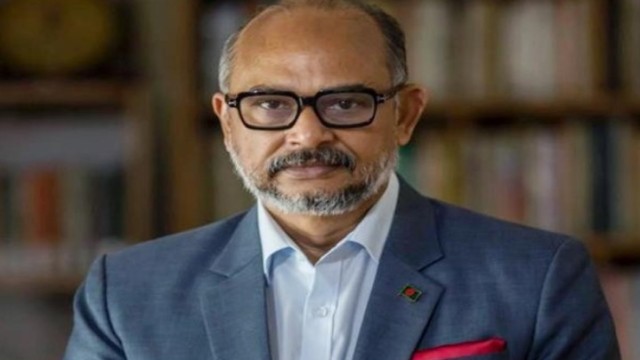
DHAKA, Nov 28, (V7N) — Prime Minister's Finance and Planning Adviser Professor Dr Rashed Al Mahmud Titumir today said confidence, trust and accountability in the country's financial sector are returning, citing improved depositor confidence and smooth withdrawal of deposits from Sammilito Islami Bank.
"Depositors are now happy as they are able to withdraw their deposits smoothly," he said, referring to the situation at Sammilito Islami Bank, which was formed through the merger of five troubled Islamic banks.
He said restoring public confidence in the banking sector, ensuring accountability and strengthening institutional governance are essential for reviving economic activities and achieving sustainable economic growth.
Titumir made the remarks as the chief guest at a roundtable discussion titled 'Ethics in Banking: Accountability and Trust', organised by Arthakantha at a hotel in the capital.
The adviser also proposed reducing the policy rate to 7 percent from the existing 9.5 percent to encourage investment, reduce borrowing costs and stimulate economic activities.
"The government does not set the policy rate, as Bangladesh Bank is an autonomous institution responsible for determining it. Personally, I believe Bangladesh Bank's policy rate is quite high and should be brought down to 7 percent. Many economists may raise questions about this, but I think it is reasonable," he said.
He also proposed fixing the interest rate at 7 percent for the refinance scheme to make financing more affordable for businesses and investors. Explaining his proposal, Titumir said the high cost of financing is discouraging investment and constraining the expansion of economic activities. He acknowledged that reducing the policy rate amid prevailing inflationary pressures could raise concerns among economists, but said alternative monetary policy approaches could also be considered, citing Japan as an example where the policy rate remains below the inflation rate.
Currently, Bangladesh Bank's policy rate, known as the repo rate, stands at 9.5 percent. The rate serves as a key monetary policy instrument through which the central bank provides short-term liquidity to commercial banks and influences overall borrowing costs in the economy.
The adviser stressed that restoring confidence in the banking sector requires not only monetary policy adjustments but also comprehensive reforms to improve governance, ensure transparency and strengthen accountability in financial institutions. He said the banking sector needs to be strengthened to support productive investment, employment generation and overall economic recovery.
Referring to the country's economic statistics, Titumir alleged that GDP figures during the previous Awami League government had been overstated, saying the practice began in the 2014-15 fiscal year. He emphasised the need for transparency and credibility in economic data, saying reliable statistics are essential for sound policymaking, investment decisions and effective economic management.
On the capital requirements of the banking sector, he said the country's GDP is currently around US$80 billion and that recapitalisation equivalent to 11 percent of GDP is required to address the sector's capital needs. He also expressed concern over the substantial increase in foreign debt during the previous government, saying the country's external debt had risen by 323 percent.
The adviser said addressing weaknesses in the banking sector, ensuring responsible lending and restoring financial discipline would be crucial to rebuilding confidence among depositors, investors and other stakeholders.
The roundtable discussed ethical banking practices, transparency, accountability, depositor protection and the challenges of rebuilding public confidence in the country's financial sector.
Mustafa K. Mujeri, executive director of the Institute for Inclusive Finance and Development (InM), presented the keynote paper, while Nahidul Khan, advisory editor of Arthakantha, chaired the session.
Dr Arifur Rahman, chairman of Premier Bank, also spoke at the discussion, highlighting the importance of ethical banking practices, accountability and good corporate governance in ensuring the stability and sustainability of financial institutions.
Participants emphasised the need for stronger regulatory oversight, responsible lending practices, transparency in financial operations and institutional reforms to build a resilient banking sector and protect depositors' interests. They also underscored that restoring public confidence would require consistent policy support, effective supervision and accountability at every level of the banking system.