Washington, Aug 08 (V7N) – A federal appeals court has ordered the Trump administration to halt above-ground construction of a planned $400 million ballroom at the White House, ruling that the project cannot proceed without congressional approval.
The US Court of Appeals for the District of Columbia Circuit issued the decision Friday (August 7) in a 2-1 ruling, siding with the National Trust for Historic Preservation, which challenged the administration's authority to undertake the project.
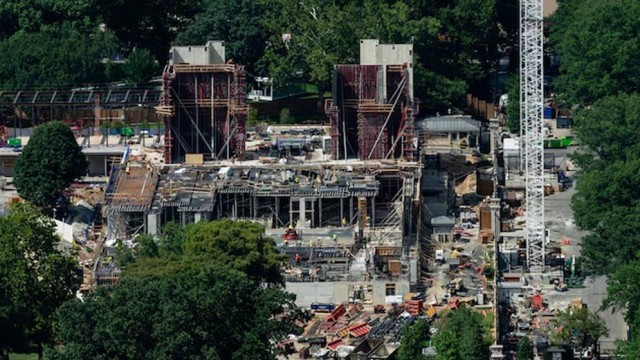
The proposed 90,000-square-foot ballroom is being built on the site of the demolished East Wing of the White House. The court ruled that the president does not have unilateral authority to make such a major structural change to the historic complex without authorization from Congress.
In its ruling, the majority emphasized that presidents are temporary occupants of the White House rather than its owners, and said the decision on whether to construct such a major addition belongs to Congress.
The appeals court's ruling upheld an earlier preliminary injunction issued by US District Judge Richard Leon, who had previously halted above-ground construction while allowing certain underground work connected to national security to continue.
The Trump administration has argued that the project is necessary to provide a larger venue for major events and to improve White House security. Government lawyers also argued that the courts lacked authority to intervene in a privately funded project and raised national security concerns surrounding the existing White House complex.
The National Trust for Historic Preservation welcomed the appeals court decision, saying it protects public involvement in decisions concerning historic buildings.
The ruling does not permanently prohibit construction of the ballroom. The appeals court has temporarily stayed enforcement of its decision for 14 days, giving the administration an opportunity to seek review by the US Supreme Court.
The case has become a significant constitutional dispute over the limits of presidential authority, congressional oversight and the preservation of the White House as a historic national landmark.
The project has also faced controversy over its cost and funding. The administration has described it as a privately funded project, while the legal dispute has focused on whether the executive branch has the statutory authority to undertake such a major alteration without congressional authorization.
With the legal battle now potentially heading to the Supreme Court, the future of Trump's proposed White House ballroom remains uncertain.
END/SMA/AJ