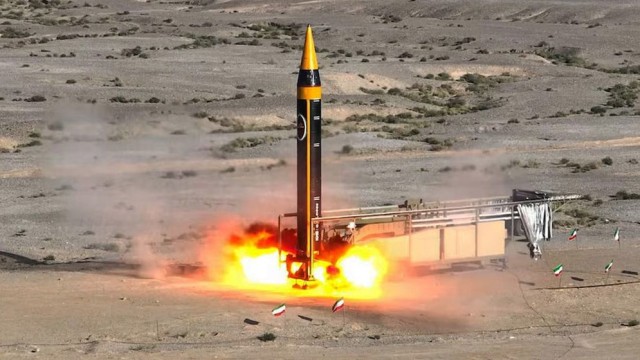
Tehran, July 26 (V7N)- Iran's Kheibar Shekan ballistic missile has attracted renewed international attention following its reported use during the ongoing regional conflict involving the United States, with analysts highlighting its mobility, maneuverability and comparatively low production cost.
According to a report by The Wall Street Journal, the missile has become one of Iran's most closely watched weapons systems amid recent military exchanges in the Middle East.
The Kheibar Shekan, developed by Iran and introduced into the arsenal of the Islamic Revolutionary Guard Corps (IRGC) in 2022, is a solid-fuel ballistic missile designed for rapid deployment. Unlike liquid-fuel missiles, it can be prepared in advance and launched from mobile platforms, allowing operators to relocate quickly after launch.
Military analysts say the missile is designed to maneuver during the final stage of its flight, making interception more challenging for missile defense systems.
Reports also suggest that one of the missile's key advantages is its relatively low production cost compared with the high cost of interceptor missiles used by the United States and its allies, potentially increasing the economic burden of sustained missile defense operations.
The Wall Street Journal reported that Iran's missile development program has benefited from years of research by Iranian scientists and engineers, who have studied modern conflicts and missile defense technologies to improve the performance of domestically produced weapons.
The Kheibar Shekan was publicly unveiled by Iran in 2022. Iranian officials have said it is capable of carrying different types of warheads, though they have not disclosed production costs or detailed technical specifications.
The missile's name is derived from the historic Battle of Khaybar in 628 CE, a reference that Iranian authorities have said reflects historical symbolism rather than technical characteristics.
The Kheibar Shekan has previously been reported by Iranian media to have been used during military operations involving Israel. Independent verification of all battlefield claims made by parties to the conflict remains difficult.
END/SMA/AJ