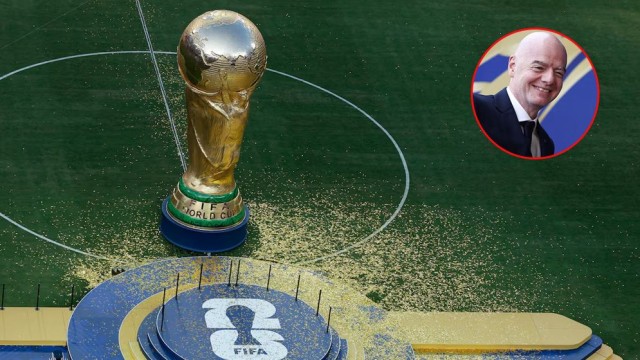
Zurich, Jul 22 (V7N) – FIFA President Gianni Infantino has suggested that football's governing body could consider expanding the FIFA World Cup to 64 teams in the future, a proposal that has already sparked debate over its impact on the global game.
Speaking in a recent interview with Swiss television, Infantino said the possibility of a 64-team World Cup could be explored beyond the 2026 tournament, which is being held for the first time with 48 participating nations.
If implemented, the proposal would significantly reshape the tournament's structure, requiring more stadiums, hotels, transportation infrastructure and a longer competition schedule. Under the current 48-team format, the World Cup features 104 matches. Expanding to 64 teams under the same format would increase that number to 128 matches, likely extending the tournament by at least another week.
The proposal has drawn criticism from several football leaders.
UEFA President Aleksander Čeferin argued that a 64-team World Cup would weaken both the finals and the qualification process, while Asian Football Confederation (AFC) President Sheikh Salman bin Ibrahim Al Khalifa questioned where expansion would ultimately end if FIFA continued increasing the number of participating teams.
Infantino, however, defended the concept, saying the World Cup should represent the entire football world rather than being dominated by Europe and South America.
According to the FIFA president, giving more opportunities to smaller football nations would encourage investment in the sport and accelerate the development of football in emerging countries.
A further expansion could also have major financial and sporting consequences. Easier qualification for the World Cup could reduce the commercial value of qualifying competitions, potentially affecting broadcasting revenue earned by regional football confederations while increasing FIFA's financial influence.
The proposal would also place greater demands on future host nations. Spain, Portugal and Morocco will jointly host the 2030 FIFA World Cup, with the opening matches scheduled to take place in Uruguay, Argentina and Paraguay. Saudi Arabia, the sole host of the 2034 tournament, would face even greater logistical challenges if the competition were expanded to 64 teams, requiring additional investment in stadiums, training facilities, hotels and transport networks.
Analysts have also warned that a larger World Cup could further complicate the international football calendar. With more domestic leagues, including Japan's J.League and Major League Soccer in the United States, moving toward an August-to-May schedule, a longer World Cup could create greater disruption to club competitions.
Financial concerns have also been raised by national football associations. The French Football Federation estimates its participation in the 2026 World Cup will cost around €24.5 million and has called for greater financial support from FIFA, warning that teams face financial risks if they fail to progress deep into the tournament.
Critics have also pointed to the possibility of increased player workload, longer tournament durations, higher travel and accommodation costs for supporters, and concerns that expanding the competition too far could diminish the World Cup's traditional prestige.
Whether FIFA ultimately pursues a 64-team World Cup is expected to depend largely on the success of the expanded 48-team format introduced in 2026.
Source: Reuters
END/SMA/AJ