


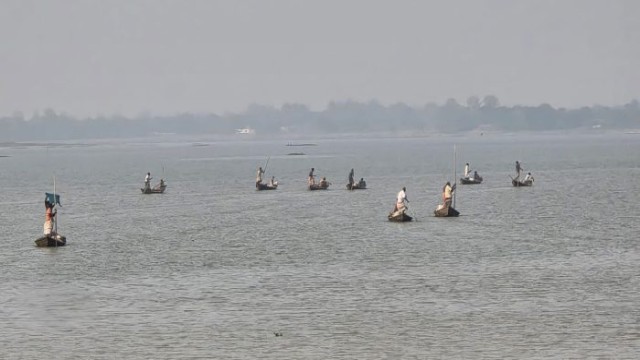
Rajshahi, Dec 18 (V7N) — The Shib River, once deeply intertwined with the lives and livelihoods of people in Rajshahi, Chapainawabganj, and Naogaon districts, is now facing a severe existential crisis. Once a vibrant river supporting agriculture, fisheries, navigation, and the local economy, the Shib today remains dry for most of the year, its riverbed dominated by silt, sandbars, and water hyacinth. As a result, fish stocks have sharply declined, with only small indigenous species now commonly found, while many native fish varieties have disappeared altogether.
Historically known to locals as the Shib Nadi, the river is located in the Barind region, about 20 kilometers northwest of Rajshahi city. It originates from the wetland areas south of Sapahar Upazila in Naogaon district and flows southward for approximately 45 kilometers before merging with the Barnai River near Nawhata in Paba Upazila, after which it flows northeast. The river passes through Niamatpur and Manda upazilas of Naogaon, Paba and Godagari upazilas of Rajshahi, Mohanpur to the east, and Chapainawabganj Sadar and Nachole upazilas to the west, also skirting Tanore.
Local residents identify the Shib as a distributary of the Mahananda River. In the past, it remained full during the monsoon season, enabling fishing, irrigation for crops, and transportation of goods by boats. Over time, however, reduced upstream water flow, illegal encroachment, heavy siltation, and the absence of regular dredging have rendered the river nearly dead.
Field visits reveal that in many stretches the water is now so shallow that people can cross it on foot. In several places, agricultural land, bamboo groves, houses, and other structures have encroached upon the river’s natural course. During the monsoon, even moderate rainfall causes waterlogging in surrounding areas, while in the dry season farmers suffer from acute shortages of irrigation water.
Ansar Ali, a farmer from Kaliganj in Tanore, said that rice, wheat, mangoes, and vegetables were once cultivated using water from the Shib River. Now, dependence on deep tube wells has increased, significantly raising production costs and reducing soil fertility. As a result, the use of fertilizers and pesticides has increased.
Fishermen also report being forced to abandon their traditional livelihoods due to dwindling fish stocks. Many say that even after casting nets all day, they often fail to catch five kilograms of fish. Fisherman Haridash Pal noted that although fish prices are now higher, without that price increase survival would have been impossible compared to the past when fish sold for only a few taka per kilogram.
Another fisherman, Makhan Ali, said that species such as sing, koi, boal, magur, tengra, rohu, catla, and mrigel were once abundant. While some of these species are still found, their numbers and sizes have drastically declined. Currently, small fish like puti and darkina dominate catches, with only a few other indigenous species appearing occasionally.
River expert Mahbub Siddiqui of Rajshahi emphasized that the Shib River is not merely a water channel but a crucial component of the region’s ecological balance. He said that a healthy river helps maintain groundwater levels, protect biodiversity, and reduce the risk of natural disasters. Like the Padma, he warned, the Shib River is now on the verge of death due to encroachment and the absence of dredging.
He recalled that regular launch services once operated along the Shib River. He himself traveled by launch two years after Bangladesh’s independence, and even in 1982, daily launch services ran from the historic Nawhata river port in Paba via the Shib River, making it a vital inland waterway.
Mahbub Siddiqui further explained that in the early 1960s, local residents constructed an embankment at Baidyapur in Manda Upazila of Naogaon for flood control. Since then, the natural flow of the Shib River has been obstructed, leading to its gradual decline. He stressed that removing this embankment is essential to restore the river’s flow and revive the historic Shib River.
END/MRA/SMA/



















Comment: